From reactive to strategic: Rethinking workforce planning for the municipal future
September 17, 2026
Municipal workforces are changing alongside the tools and skills shaping how services are delivered. A more strategic approach to workforce planning can help leaders build capacity, develop their people, and make thoughtful use of AI while staying connected to the communities they serve.
Municipal leaders are familiar with the pressure to do more with less. This pressure has only intensified as the pace of change accelerates, increasing day-to-day complexity and the need to be future ready. However, the range of tools, skills, and available ways of working are also evolving — and can help municipal leaders respond.
That also changes how workforce pressures can be addressed. As the work changes, replacing what was there before may not prepare a municipality for where the work is heading. This makes it crucial to shift the focus from headcount to the skills and capabilities of the future. Reimagining the roles required and augmenting jobs that align to new ways of working are becoming necessary to optimize talent and resource allocation.
The 2026 MNP Municipal Report summarizes responses from 292 local government leaders across Canada and highlights opportunities for municipalities to strengthen long-term planning.
Only 18 percent of municipalities report using proactive, data-driven workforce planning. When organizations experience workforce shortages, 47 percent rely on temporary staffing, while 37 percent turn to recruitment campaigns, and 28 percent prioritize reskilling or upskilling programs.
That creates an opportunity to rethink the starting point. When someone leaves, the first conversation doesn’t automatically have to be about replacing that position.
It can open the discussion to the following:
- Does the role still make sense as designed?
- Has the work changed?
- Could those responsibilities sit somewhere else?
- What capabilities will the organization require next?
That is where workforce planning starts to become strategic and helps prevent pressure from becoming urgent.
Start with where your municipality is going
Local government is complex. A single organization can effectively contain dozens of different businesses, from public works and planning to recreation, finance, transit, and emergency services. Each has different skills, operating pressures, and service expectations. And trying to transform all of them at once would be difficult and, in many cases, unnecessary.
But a great first step is setting a clear direction. Senior leadership can establish where the organization is heading, what it is trying to accomplish, and which service pressures deserve attention first. Without that direction, individual departments may still make progress, but activity can quickly become fragmented.
A useful starting point is to look at:
- The services residents and businesses will expect in the coming years
- Where demand is growing faster than current capacity
- Which processes are consuming significant employee time
- Where vacancies or retirements could create capability gaps
- Which roles may change as digital tools and AI become part of everyday work
- What skills employees will require to work effectively in that environment
This also changes how leaders think about a vacancy. Instead of automatically looking for the same person with the same skills to perform the same responsibilities, there’s another opportunity to consider the organization as a whole.
It still comes back to having the right people, in the right roles, doing the right things. The key is connecting those decisions to the services and outcomes the municipality is working toward.
You might also be interested in
The skills around the work are changing too
The report offers another clue about where workforce planning is heading. Municipal respondents identified leadership at 58 percent and digital literacy at 53 percent as critical future capabilities, and these two capabilities are connected.
Historically, someone could rise into senior municipal leadership because they were exceptionally good within their technical area. A highly capable public works professional, for example, might become the manager and eventually the senior leader.
Technical experience brings an incredibly valuable foundation to municipal leadership. Digital tools and AI are adding new considerations to that role, particularly as decisions around technology increasingly connect people, processes, and service delivery across the organization.
This is where capabilities such as change leadership, strategic foresight, problem solving, and digital literacy come into play. Digital literacy gives leaders the context to understand what can be done and how new tools may affect the work, while digital/AI capabilities give leaders the understanding of how work is done. Strong leadership involves building knowledge and awareness of what can be done within the organization, helps bring people through change, and keeps decisions connected to council priorities and outcomes for the community.
That combination becomes important as employees themselves build deeper technical skills. Leaders can create the direction and environment for those abilities to be put to work across the organization.
It also calls for critical thinking — AI can accelerate work, but cannot replace the judgment, context and human connection involved in serving a community. As roles evolve, those distinctly human capabilities become part of the workforce conversation too.
Reskilling can start small
The report found that only 25 percent of municipalities have an organization-wide reskilling strategy, while 22 percent have no strategy at all.
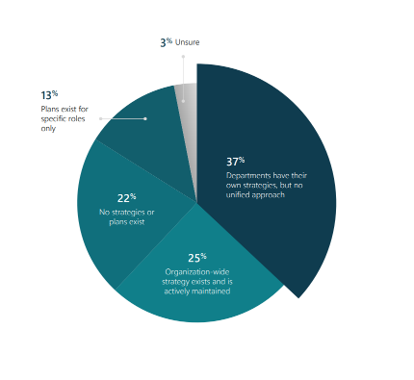
An organization-wide strategy can start small. In fact, smaller use cases can make learning practical and it becomes much easier when employees can connect it directly to the work in front of them.
Start with a problem that employees already recognize. A team may be handling a high volume of applications without additional capacity. HR may be spending significant time on repetitive administrative work. Another department may have a process requirement that consistently slows service delivery.
Once the problem is understood, employees have a reason to develop a new skill because they can see what it helps them accomplish.
One local government’s experience demonstrates how this can work in practice. The organization had approximately 600 job classification descriptions, including significant duplication. AI was used alongside human review to help consolidate those descriptions to approximately 250.
The learning didn’t stop when the work was complete. Employees wanted to understand how it had been done. What prompts were used? How was the output validated? How were inaccuracies and hallucinations identified?
Those methods became part of the handover and illustrates how AI can move from an abstract concept to an actionable workplace skill. Employees had seen it applied to their work, understood the safeguards, understood where human was necessary, and had an example they could build from.
That kind of experiential learning can also surface internal champions. Some employees will experiment, learn quickly, and begin helping their colleagues. Reskilling starts to spread through the work itself.
Municipalities have been through versions of this before. Think of how HR information systems replaced paper files and filing cabinets. Digital processes are no different in how they changed work that had historically been manual. AI may introduce different capabilities and risks, but many of the disciplines that help people navigate change aren’t new.
Move from learning to implementation
Training can lose its impact when employees can’t see how it connects to their work.
To just ask, learn AI is an enormous request, but when you pose it as, let’s learn how to use it together, it gives people something tangible to work toward.
Adults often learn best through application. Leaders are busy and so are employees, however, an opportunity to experiment can help ease the ask and build confidence through experience.
The progression can be relatively straightforward:
- Learn: Understand the technology, its potential applications and its risks.
- Experiment: Apply it to a defined problem where employees can test and learn.
- Optimize: Take what worked and improve how the tool fits into the process.
- Share: Give peers an opportunity to learn from the people who have already put it into practice.
That takes reskilling out of the classroom and puts it into the day-to-day work.
Keep the workforce people-powered
Municipal work ultimately comes back to the people and communities being served. As new tools become part of day-to-day work, the human qualities behind that service remain central.
Critical thinking, judgment, and empathy shape how employees apply technology and how their work lands with the people on the other side of it. That human perspective brings the context and care that technology alone cannot provide.
Bringing people and technology together can create greater capacity while keeping the connection to citizens firmly in place.
Build a more future-ready workforce
MNP works with municipalities to assess workforce gaps, define future roles, and build structured workforce and reskilling strategies aligned with organizational priorities.
Connect with our team to discuss how your municipality can move from reactive workforce decisions toward a more proactive approach.
Author
Author
Connect with us to get started
Our team of dedicated professionals can help you determine which options are best for you and how adopting these kinds of solutions could transform the way your organization works. For more information, and for extra support along the way, contact our team.